This is just a short followup about something I noticed in the LOTR map. To begin with, let me show you the area of the map I am talking about:

For starters, the Lord of the Rings was written after The Hobbit, and so Tolkien when drafting the map for LOTR did an interesting trick, which was to include TWO representations of Germany.

The first representation is pre-WW2, and as I wrote about before, Scotland is represented by Mirkwood Forest, and far to the east are the Iron Hills. If you read my previous blog post about this, it will explain that Tolkien changed canonical-north of a real map of the world in order to reorient Northern Scotland to be straight up and down, and thereby caused Germany to be directly east, which were The Iron Hills, symbolizing the rise of Nazi Germany and their iron mining and steel production and industry.

And here we have the second representation of Germany, and the LOTR story is unsurprisingly a reflection from post-WW2 about the need to stop another such world war in the future. Germany in this part of the map is Mordor, and in a previous blog post I show that Tolkien squashed the pre-WW2 borders of Germany like a sandwich in order to make the mountains around Mordor follow the same lines.
But if you look up at the top-right of the image, you can see the Sea of Rhun. What is that? That area actually represents the horrific Siege of Leningrad.
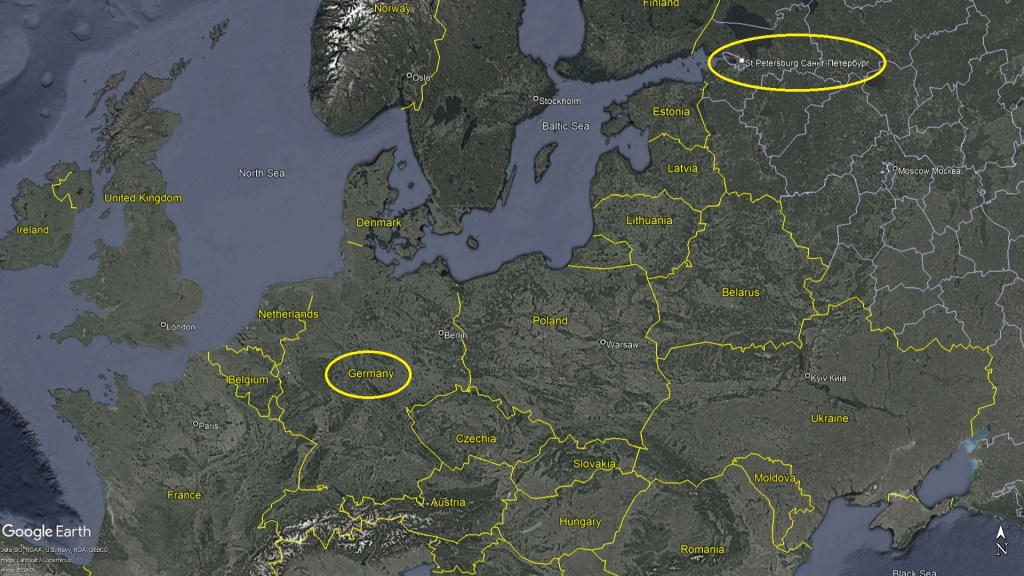
If you look here at the position of both Germany and the city of St. Petersburg, which was called Leningrad in Soviet times, you can see that there is an argument to be made that perhaps Rhun represents Leningrad.
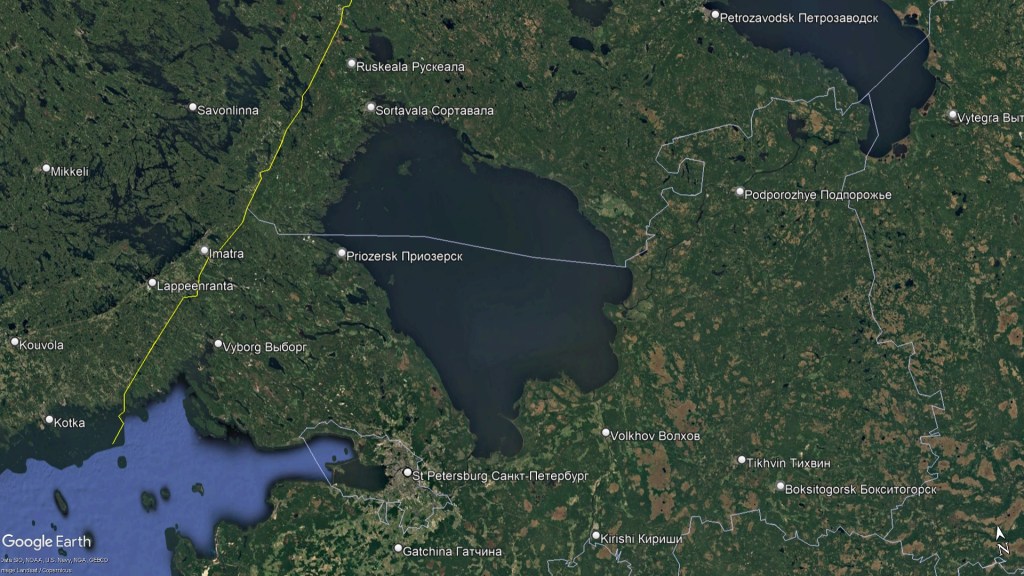
Looking closer at former Leningrad, you can see St. Petersburg on the southwestern side of Lake Ladoga. A little more ancillary detail about the wartime conditions around Lake Ladoga is that on the northeastern side of the lake, it was significantly forested, and this had a strategic effect on the war which I admit I’m not familiar with, but I imagine that both mechanized warfare and infantry combat in the forest were not optimum conditions for the Russians or the Germans.
When the Nazis invaded the Soviet Union and reached Leningrad, they couldn’t capture the city, and the siege lasted 872 days before they departed. The total death-toll is estimated to have been about 1-million Soviet soldiers killed, 580000 German and Finnish soldiers killed, and somewhere between 600000 and 1.5-million civilians killed.
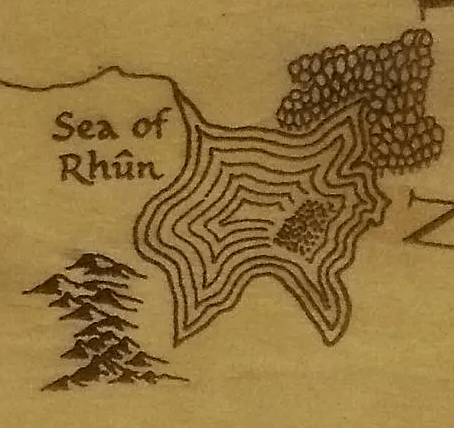
Here in a close up of the Sea of Rhun, you can see mountains in the place Leningrad was when next to Lake Ladoga, which was a tribute to the costly effort by the Soviets to prevent their city from being captured.
Lastly, I believe the word ‘Rhun’ in Sea of Rhun is a small word-play by Tolkien about the population of Leningrad needing to flee the siege. Tolkien fans have speculated for a long time why Tolkien drew dots in the middle of the Sea of Rhun, and I believe that they represent the horrendous death-toll of the Seige of Leningrad.

 Unsupported Speculation
Leave a comment