Or how gardens of raked gravel and large stones helped feudal lords and the warrior classes prepare themselves mentally for invasion fleets.
What’s he going on about now!?
To begin this, I’d like to show you the Yellow Mountains of eastern China. Take a look:

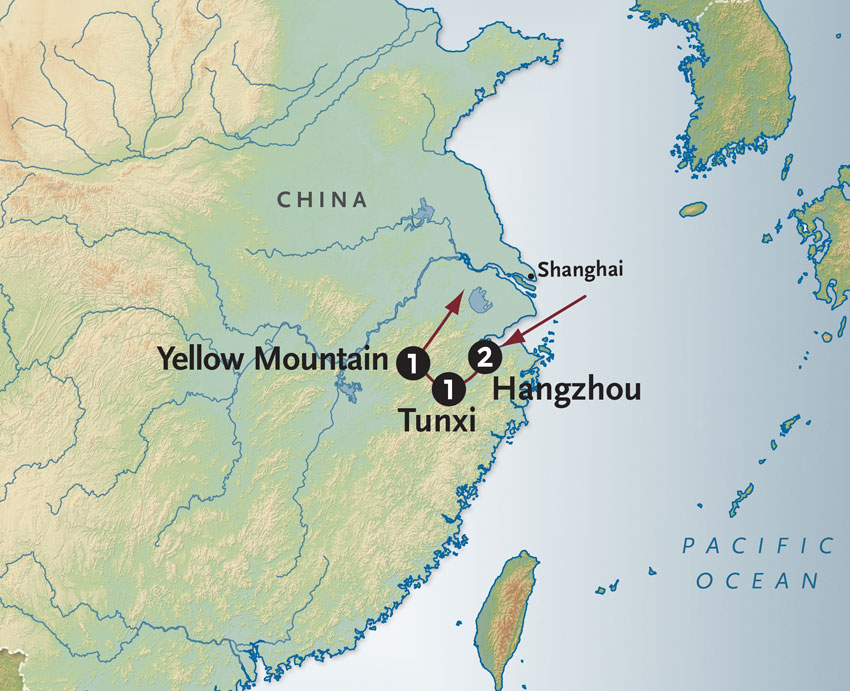
Tall and narrow mountains like them are a unique feature of two places I know of in China. One mountainous area is actually far from Japan in western China. But, the Yellow Mountains are in eastern China, close to the coast with the Pacific Ocean, and a bit south of Korea. Take a look at this map:
Now, this general place is rather famous historically. The Mongols used to rule the area, and in the 1200s, they set off on an invasion of Japan from here with a fleet. Here is a map:
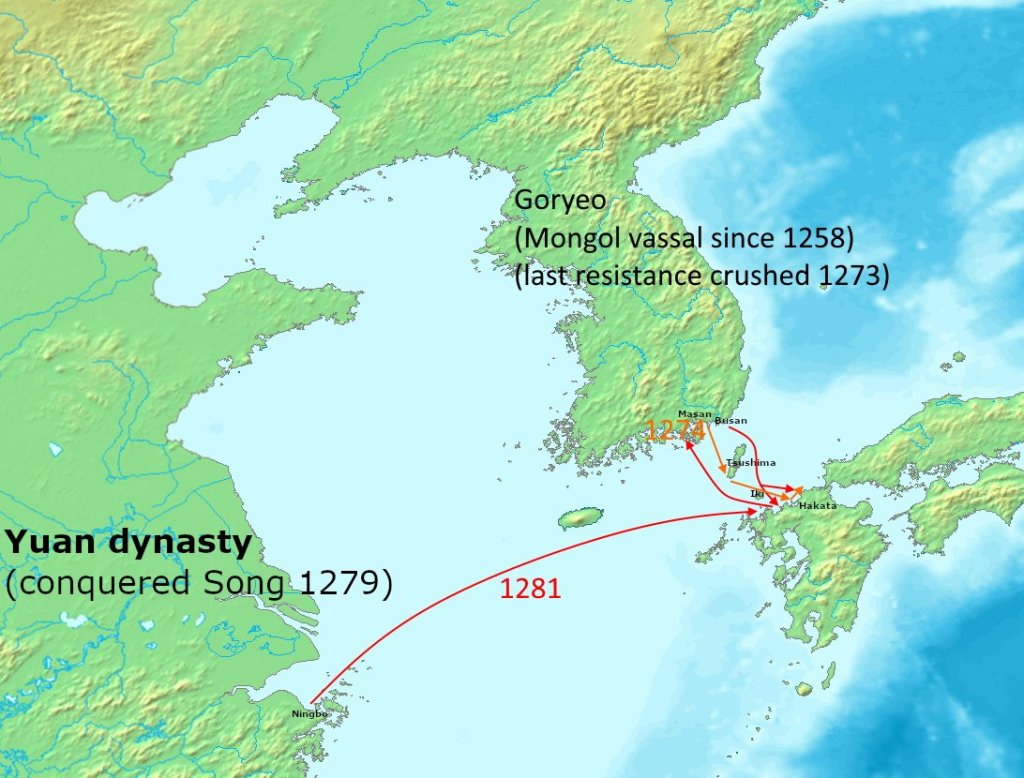
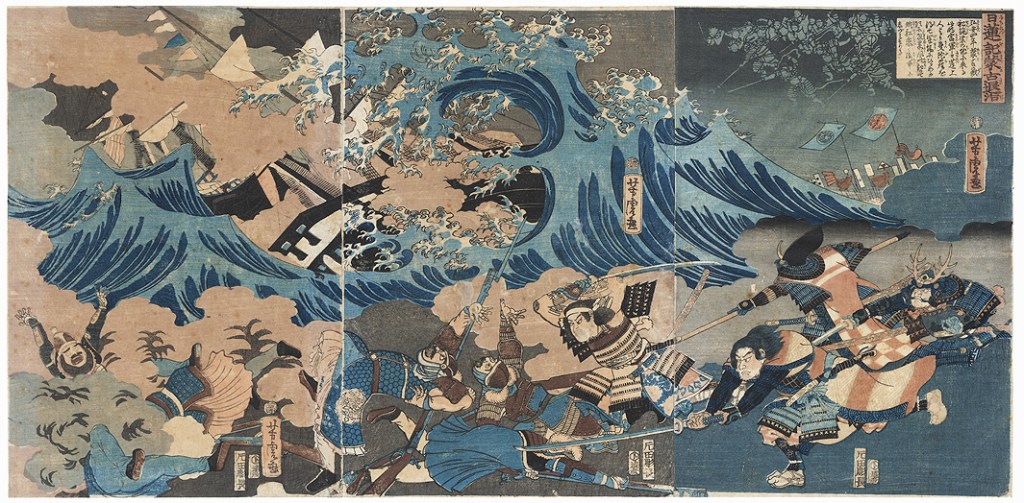
Now, there were two Mongol invasion attempts of Japan, and both fleets succumbed to being destroyed offshore while at anchor by being sunk by typhoons. This all occurred in the 1200s, and included Chinese and Korean warriors among the Mongols.
Now a very important thing to know about the unusual circumstances that led Japan to endure unceasing threat from the continent to the west is that winds between China and Japan blow ONLY east. In the day of sail, this meant it was easy to reach Japan from the west, but that the Japanese couldn’t easily sail against the winds in the opposite direction to reach China or Korea.
Now to get back to the Rock Gardens, Japanese gardens used to look a lot different before they were of raked stones and large boulders. Instead, they were designed like Chinese landscape gardens, and the idea behind those is that you would walk through those gardens, and each ‘opening’ into a new area was a new ‘scene’ to spectate. This meant you have clearings of ground with neatly tended to plants and foliage, ponds, bridges to cross, ext., all over a fairly large area, each area like a compartmentalized visual experience.
But after the 1200s when the two invasion attempts occurred, the climate took a strange turn, and everywhere from Japan all the way to India experienced a long period of increased dryness, drought, and occasional flooding.
Flooding itself seems to be a contradiction, but you have to understand that flooding itself is more likely when the soil is dry. This is because when the soil is completely arid, then obviously there is little to no water permeating and saturating the interior. Permeation of water allows more water easily into the interior, but lack of water done NOT make it more absorbent. Instead, water is blocked. Dry soil creates a situation when if there is sudden and significant rain, then fine particles of silt in this extremely dry soil forms a barrier that prevents water from soaking into the ground, and instead it runs over the surface, and a WHOLE LOT OF IT.
This is what happened for a long period of time after the Mongol invasion attempts, and Japan and its potential threats to the west devoted their time towards adapting to a sharp decrease in rainfall, and the food shortages this resulted in. This period of dryness lasted 110 years, with 50 of them being significantly extreme in its droughts.
You have to remember that Japan and southern China relied before on the annual monsoon season to provide plentiful water for their rice paddies. But, when the climate changed, not only did monsoons become sharply less frequent, but typhoons decreased as well. Typhoons which had in the previous century decimated two Mongol invasions.
Now Zen Gardens themselves were funded by Japanese feudal lords, and when Chinese-style landscape gardens were no longer possible due to drought, then the design of Japanese gardens changed to those contained in a relatively small area, and of dry landscapes of small stones and large rocks.
Most interestingly, the people that USED these rock gardens at the time were feudal lords and members of the warrior classes, ie Samurai. What were they for? Possibly ruminating about the threat to the west.
You have to think about the fact that it was difficult to learn anything about the activities of their hostile neighbors from Japan. The winds blew towards them, and it was difficult to dispatch scouts or spies westward. Were they experiencing an extreme and long-duration drought like Japan was? Perhaps they knew that, but did they know for sure that the powers to the west over the water were too preoccupied with adapting to this new period of extreme dryness to build another fleet and raise an invasion force? They probably didn’t know that for sure.
Remembering that this was going on in the century AFTER the Mongol invasions, and that this is a long time to lose tabs on what was happening in Mongolia, Korea, and China.Another full fleet could be almost completed in its construction, and its army already raised.
And so this is why Zen Rock Gardens were actually contemplation and rumination spaces for considering the possibility of another invasion fleet arriving and landing at their beaches. Throughout this dry period, the Japanese lords were in the midst of fighting themselves in civil war, but if one of the powers to the west managed to arrive at their shores, then feudal lords had to consider the prospect of needing to pivot their forces to repelling an invasion while simultaneously being distracted by a local rival lord vying for more territory.
This is why Rock Gardens actually reference the Yellow Mountains of eastern China. It was to remind the ruling and warrior classes of Japan where last the invasion set off from, and they contemplated the unknowable answers to the questions of how distracted their enemies were from the same droughts everyone was experiencing. These rock gardens may have even been spaces for lords to get ideas for gathering information about what was happening west over the water. They were places devoted to a subject visually in order to arrive at the most mature ideas about a complicate matter.


Top: ChatGPT rendering of the Yellow Mountains of China during extreme drought.
Bottom: Zen Rock Garden in Japan.
You see, during this ancient period, it was traditionally rains that prevented the movement of armies, and rain is seasonal in the east due to the monsoon season. But after the climate changed to one of extreme dryness, then the specter of threat loomed that an army couldn’t get immobilized by torrential rainfall, and with significantly less typhoons in this period then there were in the past, then a typhoon was less likely to save them in the event of another invasion fleet.
But, an army marches on its stomach, and what armies tended to do back then was help themselves to the food of farms and wilderness around them, because depending on long-distance logistics for food rations was more difficult to do the farther an army has marched, and these supply lines were vulnerable to being ‘cut’ by an enemy force behind a main army.
Logistics was nearly impossible from over the water, but the question still plagued the lords and samurai, which was whether anyone had managed to build a THIRD fleet, and had raised an army supplied with provisions to make the invasion transit. If they HAD, they might be depending on raiding the Japanese themselves for sustenance during their invasion.
And this is why the feudal lords funded the new Rock Gardens. They provided a rumination space for Japanese ruling and warrior classes to not forget that the Mongols arrived off their shore in the 1200s, borne on about 4,000 ships, and bringing with them between 140,000 to 150,000 troops, and only perished because of the chance coincidence of a typhoon. The possibility of that happening again was far more dangerous than the in-fighting the were engaged in with rival lords.
So they were prepared for the prospect of another invasion arriving, and needing to meet them with their Samurai and archers on the beaches or farther inland.

 Unsupported Speculation
Leave a comment